
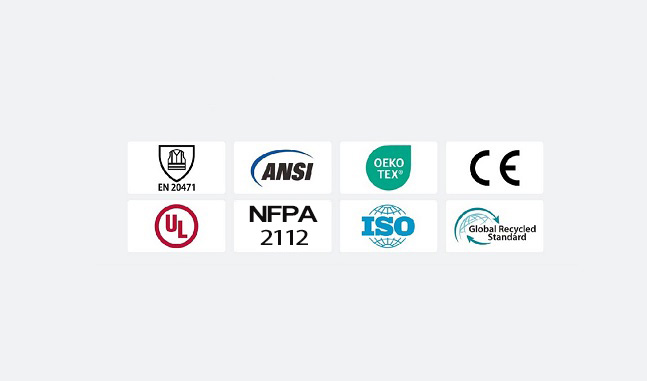
Essential PPE Purchases: Look for These 7 International Certification Marks
When purchasing personal protective equipment (PPE), certification marks are the most important guarantee of product quality and safety. As a manufacturer with 20 years of professional experience in protective equipment, we are deeply aware of the rigorous testing requirements and safety implications behind these marks. This article will provide a detailed introduction to seven key international certification marks to help you make informed purchasing decisions and avoid the safety risks and legal disputes caused by substandard products.
1. CE Certification - A Passport to the European Market
The CE mark is a mandatory certification for PPE entering the European Economic Area, certifying compliance with the requirements of EU PPE Regulation (EU) 2016/425.

This mark signifies that the product has been evaluated by an EU Notified Body, that the manufacturer has established a comprehensive quality assurance system, and that the product is accompanied by a complete EU Declaration of Conformity and technical documentation. When purchasing, it is important to note that the CE mark must be affixed to the standard size and proportions. An unclear or irregularly sized CE mark may be a forgery. According to market research, approximately 15% of products claiming to be "CE-certified" have not actually undergone formal testing.
2. ANSI/ISEA - Authoritative Standards for the North American Market
ANSI/ISEA standards are a joint system of PPE standards developed by the American National Standards Institute and the International Safety Equipment Association. They primarily include:
ANSI/ISEA 107: Standard for High-Visibility Safety Clothing
ANSI Z89.1: Standard for Industrial Head Protection
ANSI Z87.1: Standard for Eye and Face Protection
Unlike CE certification, ANSI certification is voluntary. However, US OSHA regulations explicitly require employers to provide PPE that meets ANSI standards. We recommend requesting comprehensive test reports from suppliers rather than simply stating "ANSI-compliant" when purchasing.
3. NFPA Certification - Professional Guarantee of Fire and Arc Protection
The standards set by the National Fire Protection Association (NFPA) are globally recognized for fire and arc protection:

NFPA 2112: Standard for Flame-Resistant Apparel for Industrial Use, requiring fabrics to achieve a char length of ≤100mm and an afterflame time of ≤2 seconds in a vertical burn test.
NFPA 70E: Standard for Arc Protection in the Power Industry, requiring garments to withstand specific levels of arc heat (e.g., 40 cal/cm²).
NFPA 1971: Standard for Protective Equipment for Firefighters.
Our FRARCTEX® arc-resistant fabrics are NFPA 70E certified, demonstrating actual resistance to arc shocks up to 40 cal/cm², equivalent to twice the temperature of the sun's surface.
4. EN ISO Standards - Internationally Recognized Technical Specifications
Standards jointly developed by the European Committee for Standardization (EN) and the International Organization for Standardization (ISO) are widely recognized worldwide.
This standard system covers multiple areas: EN ISO 11611 categorizes welding protective clothing into Class 1 and Class 2 protection levels; EN ISO 11612 regulates thermal and flame-retardant clothing, evaluating performance against flames, convection, and radiant heat; EN ISO 20471 specifies visibility levels for high-visibility clothing; and EN ISO 20345 specifies requirements for safety footwear, including impact resistance, puncture resistance, and slip resistance. All our products are tested according to the corresponding EN ISO standards, and test reports are available upon request.
5. UL Certification - Third-Party Verification of Safety Performance
Underwriters Laboratories (UL) is a widely recognized third-party certification in the North American market:
UL Certification: A comprehensive assessment of product safety performance
UL Classification: Certification of specific performance (such as flame retardancy and electrical insulation)
UL On-site Assessment: An audit of production facilities and quality management systems
It is important to note that UL certification is not lifelong; products must undergo regular re-inspections to maintain certification. Our insulation protection product line undergoes unannounced annual UL inspections to ensure continued compliance with standards.
6. OEKO-TEX® STANDARD 100 - Ecological Health Assurance
This international certification focuses on the ecological safety of PPE products:
Tests for over 300 hazardous substances (including formaldehyde, heavy metals, pesticide residues, etc.)
It is divided into four product levels (Class I for baby products, Class IV for decorative materials)
It requires all components (including seams, buttons, etc.) to meet the standards.
Our products are OEKO-TEX® STANDARD 100 certified, ensuring that long-term wear will not cause skin allergies or other health issues.
7. GRS Certification - Proof of Sustainability
The Global Recycled Standard (GRS) certification is particularly important for environmentally friendly PPE. It requires products to contain at least 20% recycled content, trace the flow of recycled content throughout the supply chain, and assess social and environmental responsibility practices. Our Frecotex® flame-retardant fabric, which contains 30% recycled PET, is GRS-certified, significantly reducing our environmental footprint without compromising protective performance.
Tips for Identifying and Verifying Certification Marks
Check Mark Integrity: Authentic certification marks should include the certification body number (e.g., CE 0123)
Request Certification Documents: Require suppliers to provide valid test reports and certificates
Official Website Verification: Most certification bodies offer online database verification services
Pay attention to validity periods: Most certifications require periodic renewal (usually 1-3 years)
Beware of combination marks: Irregular marks such as "CE1234" are likely forged
Common Purchasing Misconceptions
Myth 1: "Self-declaration" equals certification (in reality, many standards require third-party testing)
Myth 2: Certification from a particular country is universally recognized (different markets have different regulatory requirements)
Myth 3: The more certification marks, the better (choose certifications that meet actual usage needs)
Myth 4: Certified products require no maintenance (all PPE has lifespan and maintenance requirements)
Purchasing Decision Advice
Clarify Needs: Determine the required certification combination based on the work environment and risk type
Budget Allocation: Certified products may be 20-30% more expensive, but can reduce accident costs by 90%
Supplier Evaluation: Choose manufacturers with a comprehensive certification system (e.g., ISO 9001). 9001 Certified Factory)
Sample Testing: Verify key performance in real-world conditions (e.g., vertical burn tests on flame-retardant fabrics)
We recommend consulting a professional safety consultant before purchasing, or contacting the certification body directly for the latest standards information. Remember, compliant PPE is not just a regulatory requirement; it's a solemn commitment to employee safety. As a manufacturer with all of the aforementioned certifications, we're ready to provide you with professional technical advice and product solutions.
